
The Closed-Loop Model in Software and Hardware Product Development

Updated: Feb 12
Modern engineering practices often emphasize iterative design processes, where feedback continuously informs the development cycle. This approach can be likened to a closed-loop system—a concept borrowed from control theory that emphasizes self-regulating mechanisms through feedback. In the context of software and hardware development, treating the process as a closed-loop system ensures adaptability, efficiency, and alignment with user needs.
What is a Closed-Loop System?
A closed-loop system relies on feedback to automatically adjust its operation. For instance:
Input: Initial specifications or requirements.
Process: Development and execution of tasks.
Feedback: Insights from testing, user feedback, or performance metrics.
Adjustment: Refinements to design or implementation.
This cycle repeats, ensuring the final product evolves with accuracy and quality in mind.
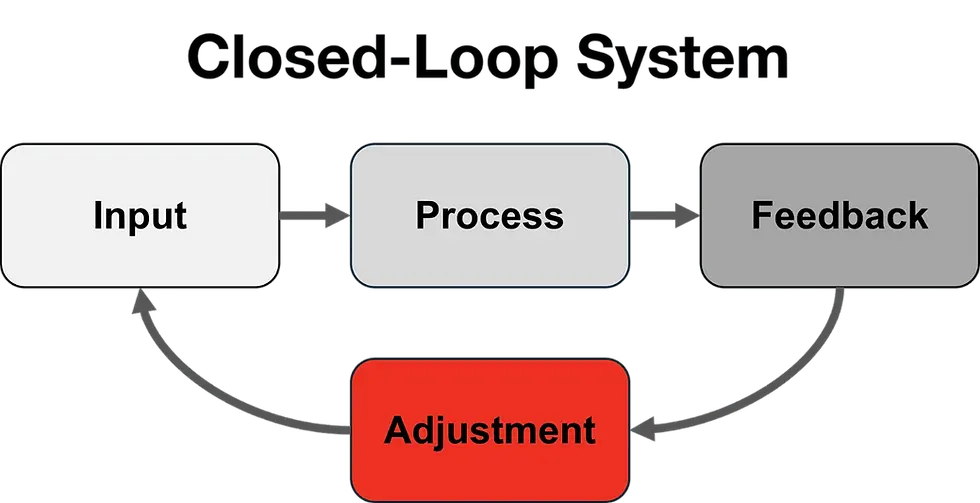
Closed-Loop Framework in Development
Inputs: Requirements Gathering
The system begins with input—market analysis, stakeholder requirements, and technical constraints. These define the starting point for both hardware and software teams.
Key components:
· User stories and personas (software).
· Functional and non-functional specs (hardware and software).
· Compatibility matrices (hardware-software interfaces).
Process: Collaborative Development
Software and hardware development processes follow distinct paths but must integrate seamlessly:
· Hardware: Circuit design, prototyping, PCB layout, and manufacturing.
· Software: Agile sprints, CI/CD pipelines, and modular codebases.
Synchronizing timelines between hardware and software teams ensures design dependencies are met.
Feedback: Testing and Validation
Feedback loops form the backbone of the closed-loop system:
· Hardware: Environmental testing, thermal analysis, and EMI/EMC compliance.
· Software: Unit tests, system integration tests, and UX feedback.
Cross-disciplinary validation (e.g., firmware running on prototypes) ensures system coherence.
Adjustment: Refinements
Feedback triggers refinements:
· Hardware teams may tweak components for better performance or manufacturability.
· Software teams address bugs, optimize performance, or adjust features.
Tools like version control systems (Git) and product lifecycle management software (PLM) maintain coherence between iterations.
Benefits of a Closed-Loop Approach
Improved Quality: Continuous feedback reduces the likelihood of major flaws.
Enhanced Collaboration: Teams gain visibility into each other's workflows, breaking down silos.
Flexibility: Adaptive systems can pivot based on evolving requirements or unforeseen challenges.
Cost Efficiency: Iterative design reduces the risk of expensive overhauls late in the development cycle.
Challenges in Closed-Loop Systems
Data Overload: Effective feedback management is crucial; too much data can bog down the process.
Synchronization Issues: Hardware often has longer iteration cycles than software, potentially causing misalignment.
Interdisciplinary Expertise: Bridging hardware-software gaps requires skilled professionals fluent in both domains.
Best Practices for Closed-Loop Development
Adopt Integrated Development Tools: Unified platforms like MATLAB-Simulink, Ansys, or cross-disciplinary tools like Jenkins and Jira bridge the hardware-software gap.
Emphasize Prototyping: Hardware prototypes enable early software testing, reducing feedback latency.
Leverage Digital Twins: Simulated models of hardware components allow software testing even before physical prototypes exist.
Ensure Clear Communication: Regular stand-ups and review meetings foster alignment.
Conclusion
Viewing software and hardware development as a closed-loop system transforms the process from linear and reactive to dynamic and responsive. By integrating continuous feedback, development teams can produce more robust, user-centric solutions. As systems grow increasingly complex, adopting this iterative mindset ensures that engineering disciplines stay synchronized in the fast-paced tech landscape.


Comments